

Understanding and Management of Food Allergies and Sensativities
Why have I been recommended to follow an elimination diet?
Your practitioner suspects that certain foods in your diet are causing symptoms of ill health.
Food allergies and sensitivities can aggravate many conditions, including skin disorders, allergies, autoimmune disease, digestive disorders and fatigue, just to name a few.
The elimination diet program will help you determine if you are sensitive to anything in your diet. This is done by initially eliminating the most common food and chemical substances to which people are sensitive. Then each suspect food is challenged individually to ascertain its effect on your body.
The program will help you discover which foods suit your body best, and help you to plan the diet most beneficial for your short-term and long-term health.
How do I follow the diet?
To begin the program, the Elimination Diet needs to be followed for 7-21 days, to allow allergens to clear from the body and symptoms to improve. Any of your symptoms which are food-related should have improved after 21 days.
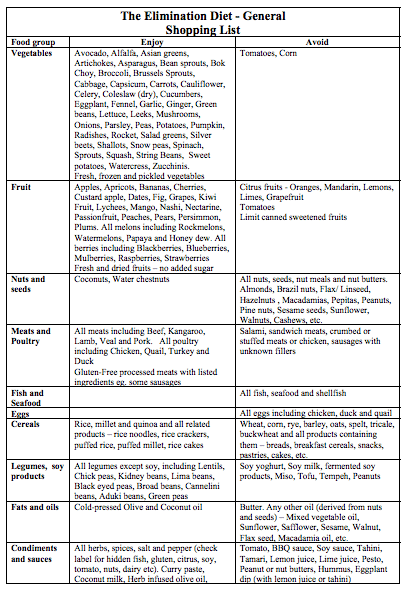
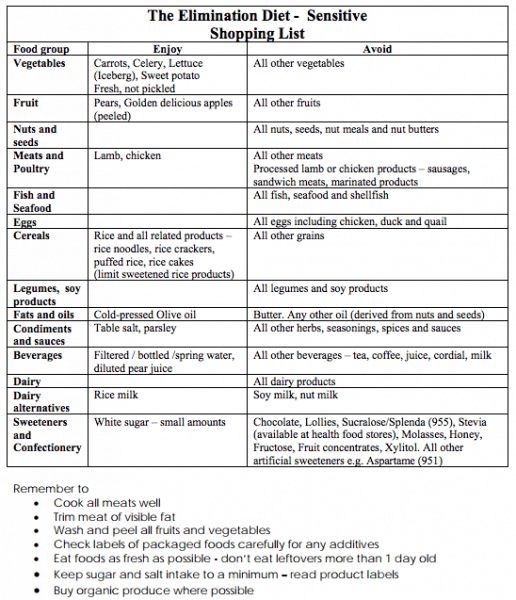
On the following pages you will find shopping lists for two different dietary plans. Your practitioner will let you know which one to follow. It is very important that you eat only the foods listed under ‘Enjoy’, and completely avoid the foods listed under ‘Avoid’. Note the special instructions for food preparation.
There is a diary provided in the following pages for you to record your daily diet and any symptoms you are experiencing. Daily recording is vital to help you and your practitioner identify the causes of your symptoms.
Why are there two diet levels?
Most people will start on the General level as a first option, and if required, will move onto the sensitive level. Your practitioner will recommend a level of the diet which suits you.
1. General Level:
The General level eliminates the most common dietary allergens, including wheat (and other gluten-containing grains), dairy, eggs, soy, nuts, peanuts, fish, shellfish, corn, tomatoes, citrus fruits, chocolate, alcohol and caffeine. Most people will find that this diet provides significant relief from food-related symptoms after a week or two.
2. Sensitive level:
For those individuals who don’t respond to the General Elimination diet, there is another dietary plan designed to pick up a wider range of food sensitivities. The Sensitive level is a diet based on those foods which are least likely to be responsible for food sensitivities or allergies. By limiting the diet to a small number of foods, all probable allergens are removed, including salicylates, amines, preservatives, colours, yeasts, legumes and certain eats, as well as the foods eliminated in the General levels.
How will I feel?
In the first few days of the diet, some people may feel tired or have cravings or headaches. This may be a result of withdrawal from caffeine and certain foods. This is a perfectly normal response, and won’t last long. Note any symptoms in your diary and please contact your practitioner if you have any unusual or prolonged symptoms or any other concerns. After the initial adjustment, the elimination of dietary allergens may result in improvement in a wide range of symptoms, such as fatigue, headaches, bloating, pain, mood disorders, skin problems and more. Once your health symptoms have improved significantly, and you have followed the diet for at least one week, you are ready to start food challenges.
How do I challenge a food?
The challenge stage involves reintroducing each group of suspect foods in turn, and carefully noting any symptoms in your diary over the following days. Any new or returning symptoms experienced are likely to be attributable to that food. The food is then removed from the diet to see if symptoms clear again.
1. The elimination diet is continued throughout the food challenge stage
2. One new food group is reintroduced every three days (see guide below)
3. At least three servings of the food need to be eaten on the challenge day, at 2-3 separate meals
4. After the challenge day, return to the elimination diet for 2 days, and observe any symptoms
5. If you react to a food on the challenge day, don’t consume any more, and return to the elimination diet. After any reaction, continue on the elimination diet until symptoms have resolved before moving on to the next challenge.
6. Challenge foods that cause no symptoms are not incorporated back into the diet until all challenges are completed
7. Challenge foods need to be challenged individually – eg. when challenging eggs, don’t serve them with cheese and bread
8. Use the patient diary to keep a detailed record of all foods eaten and your reactions throughout the elimination and rechallenge program If you react to certain foods, you are not deprived of that food group forever. However, you need to give your body a rest from the foods to which you react for the next 6 months. Gradual dietary reintroduction may be possible after this time.
CAUTION:
Do not introduce any food that you can’t remember having eaten before, or have had an obvious reaction to in the past. The body can become more vigilant for problem foods after they are eliminated for a period of time, so when you rechallenge a food, the reaction can be much more noticeable than it was when you ate the food in your normal diet. This is very helpful for identifying troublesome foods, but it may mean a more severe reaction. With unknown foods or a history of reactions, especially facial swelling or breathing difficulties, medical supervision is essential for each food challenge.
Rechallenge protocol:
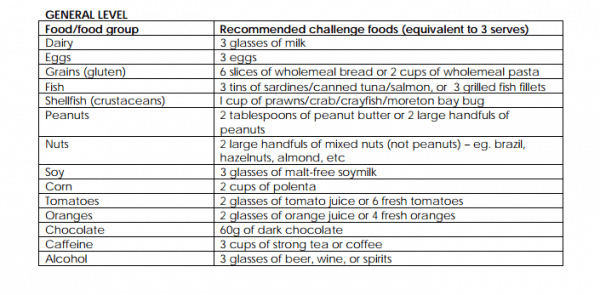
Eat the challenge foods listed below divided into to 2-3 servings over the course of the challenge day.
GENERAL LEVEL-
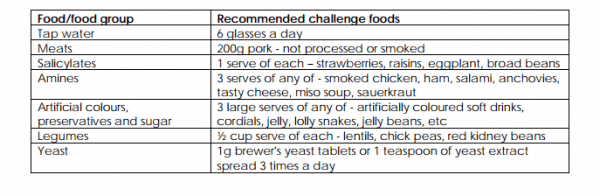
SENSITIVE LEVEL – These additional challenges are to be conducted after the above challenges are complete. Choose foods you have not identified as offenders – eg. if you are sensitive to dairy, don’t choose the cheese option for amines
FREQUENTLY ASKED QUESTIONS:
I’ve had allergy tests before, why do I need to use this diet?
Allergy tests, such as skin prick tests and blood tests can be unreliable in around 50% of cases. Both positive and negative allergy test results can be false. Food allergies and sensitivities can only be accurately identified by careful dietary elimination and rechallenge.
Will I become deficient in certain nutrients?
Nutrient deficiency on the program is unlikely if you make healthy dietary choices. Continue to eat from all the allowable food groups, including grains, vegetables, fruits, meats, and fats and oils. Your practitioner may prescribe specific hypoallergenic nutrient supplements if you require them.
Any handy hints to make the programme as easy as possible?
• Involve the whole family. This will make meal planning easier and can improve your family’s health.
• Try to start the diet at a time where you are free from social engagements and when stress levels are low, in order to make the adjustment easier.
• Children and their carers need close supervision to ensure they do not sneak in “treats” which may invalidate the diet; it may be helpful to wait for school holidays before starting the program.
• If there’s a dinner or a party you can’t postpone, you can break your diet for a day and treat the occasion as a food challenge. Record food consumption and symptoms as usual, and return to the elimination diet for at least 5 days until symptoms clear.
• If you consume caffeine on a daily basis, you may want to gradually reduce your intake over the week preceding the diet to reduce withdrawal symptoms
• Cook larger meals than you will eat so you have leftovers for snacks the same day.
For more information contact us on (07) 83 83 83 2